If a gas water-heater pilot lights but goes out when you release the control—or it stays lit briefly and then extinguishes—the safety system is not maintaining gas flow to the pilot. A weak or misdirected pilot flame, a flame-sensing problem, a gas-control fault, restricted combustion air, a venting or draft condition, or moisture near the burner can produce similar symptoms. The correct repair depends on which condition is actually present.
Do not bypass a safety switch or keep relighting the unit when you smell gas, see soot or scorching, hear delayed ignition, or have a carbon-monoxide alarm. Leave the area and follow the gas utility’s or emergency service’s instructions from a safe location. When no immediate hazard is present, record what the pilot does and arrange water heater repair rather than modifying the burner or controls.
The Timing of the Shutdown Is a Useful Clue
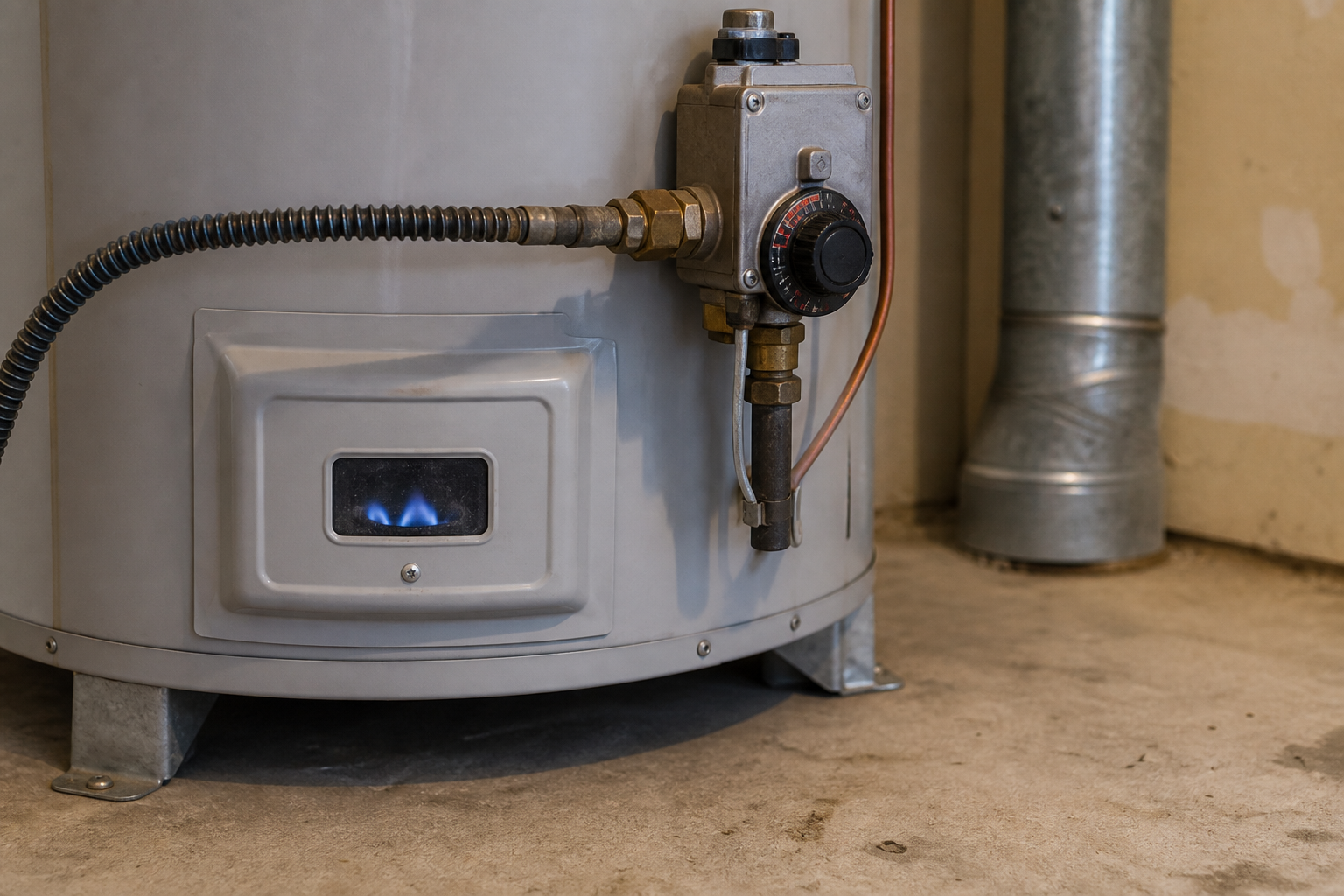
A traditional standing-pilot water heater normally uses a small flame to heat a sensor. That sensor helps the gas control verify that a pilot flame is present before gas continues flowing. The way the pilot shuts down can help a technician choose the first tests, although it does not identify a failed part by itself.
Two patterns are especially useful to report:
- The pilot goes out as soon as the control is released. The safety circuit may not be receiving a strong enough signal to keep the pilot valve open. The cause may involve the sensor, pilot-flame contact, pilot assembly, wiring or connections on applicable models, or the gas control.
- The pilot remains lit and then goes out later. Draft, combustion air, venting, changing gas pressure, overheating, moisture, or an intermittent control condition may be involved. Note whether the burner had started and how long the unit operated first.
Some water heaters use electronic ignition or a status-light control rather than a continuously burning pilot. If the unit has no standing pilot, its diagnostic sequence may be different. Use the model instructions and tell the technician what control and indicator you see.
The Flame Sensor Must Receive a Reliable Signal
Many standing-pilot heaters use a thermocouple or thermopile positioned in the pilot flame. Heat from the flame creates the signal that allows the gas control to keep the pilot valve open. If the signal is absent or unstable, the control shuts off pilot gas as a safety response.
That does not mean every pilot problem needs a new thermocouple. A service technician may find that:
- The pilot flame is too small to heat the sensor consistently.
- The flame does not contact the correct portion of the sensor.
- The sensor is deteriorated or producing an inadequate signal.
- A connection is loose, damaged, or outside the manufacturer’s specification.
- The gas control is not responding correctly even when the sensor signal is present.
- Another safety device has opened because of an operating condition elsewhere in the heater.
Do not bend, sand, jump, or bypass the sensor. Do not hold the gas control open to defeat the shutdown. The sensor is part of the system that prevents unburned gas from continuing to enter the combustion chamber when no pilot flame is confirmed.
A Weak or Unstable Pilot Flame Can Mimic Sensor Failure
A healthy pilot flame is generally steady and positioned to heat the flame sensor as the manufacturer intended. The exact appearance varies by burner and viewing window, so a photograph in a manual or online should not be treated as a universal specification.
Through the intact viewing window, a technician may ask whether the flame appears:
- Small, wavering, or easily disturbed.
- Mostly yellow instead of predominantly blue.
- Pulled away from the sensor.
- Noisy, lifting, or repeatedly shrinking.
- Stable until the main burner starts, then disrupted.
Dust, lint, deposits, pilot-orifice restriction, pressure conditions, or damage in the pilot assembly can affect the flame. Those components are inside or connected to the gas and combustion system. Do not insert a wire into the pilot opening, blow compressed air into the sealed chamber, remove the burner door, or use an open flame to test anything.
The Gas Control May Be Rejecting or Losing the Safety Signal
The gas control regulates pilot and burner gas and responds to safety inputs. A control fault can resemble a weak sensor because the pilot may light during the manual lighting step but fail when the control is expected to maintain it.
Before condemning the control, a qualified technician should compare the sensor signal, pilot flame, connections, gas supply, model-specific status code, and operating sequence. Replacing a control without those checks can leave the original cause unresolved. Gas controls also require model-correct components and installation procedures; they are not a suitable trial-and-error homeowner repair.
If the control has a blinking indicator, record the full pattern before cycling power or attempting another restart. Count the flashes and pauses, note their color, and photograph the model and serial label if it is safely accessible. The manufacturer’s code for that exact model can help direct diagnosis.
Combustion Air Can Change How the Pilot Behaves
The pilot and burner need adequate combustion air. Restricted openings, heavy dust, stored materials pressed against the heater, or an enclosed space that no longer receives enough air can affect flame stability and trigger safety behavior.
Air pressure inside the home can matter as well. Powerful kitchen exhaust, bathroom fans, a clothes dryer, or other equipment can create negative pressure in a tight building. That pressure can interfere with natural-draft appliances under some conditions. A pilot that fails only when certain fans or equipment operate is useful evidence, but it is not a reason to alter the heater, door, or vent yourself.
Keep the manufacturer-required area around the water heater clear. Do not block combustion-air openings or store paper, solvents, gasoline, paint, aerosols, or other combustibles near the unit. If the installation is in a closet or small room, have the air-supply arrangement evaluated rather than adding an improvised opening.
Draft and Venting Problems Need Prompt Attention
Natural-draft gas water heaters send combustion products through the draft hood and vent connector. A disconnected, damaged, poorly pitched, obstructed, or back-drafting vent can affect the flame and allow combustion gases to enter the building.
Stop using the heater and arrange qualified help if you observe:
- A carbon-monoxide alarm.
- Soot, dark staining, or scorch marks near the burner, draft hood, or vent.
- A loose, separated, rusted-through, or visibly damaged vent connector.
- Melted parts or repeated flame rollout outside the intended burner area.
- Headache, dizziness, nausea, confusion, or other symptoms that improve after leaving the area.
Do not place a hand over the draft hood, hold tissue near the flame, tape a vent joint, or attempt to force the heater to run for testing. Leave the area when a carbon-monoxide or gas hazard is suspected and follow emergency guidance from a safe location.
Wind and outdoor pressure conditions can also affect some vent systems. Note whether the pilot failure follows strong wind or a particular weather pattern. A technician can inspect termination, connector, draft, combustion air, and installation conditions against the model requirements and applicable code.
Moisture Near the Burner Can Extinguish the Pilot
A cold tank can produce condensation when the burner first heats a large volume of cold water. On some installations, that moisture can drip or sizzle temporarily. A leaking tank, piping connection, relief discharge, or another water source can also put moisture near the burner and controls.
Do not assume repeated water near the combustion chamber is normal condensation. Record when it appears, whether the tank had just refilled, how long it lasts, and whether any pipe or fitting is visibly wet. Avoid touching hot surfaces or wet electrical components. Do not cap or plug a temperature-and-pressure relief pipe.
If water is collecting beneath the tank, reaching the burner, or recurring after the heater is warm, stop repeated relighting attempts. The source needs to be identified before a safe repair or water heater replacement decision can be made.
Gas Supply Problems Can Look Like a Heater Failure
A pilot may fail because adequate gas is not reaching the appliance, but homeowners should not loosen fittings or adjust a regulator to test that theory. A service interruption, closed valve, supply-pressure condition, shared appliance demand, damaged connector, or control problem can change gas availability.
Check only what can be observed without touching the gas piping:
- Are other gas appliances operating normally?
- Did the problem begin after utility work, construction, or service on another appliance?
- Does the pilot weaken when the main burner tries to start?
- Is there a gas-utility notice or known interruption?
- Is the manual shutoff handle visibly in a different position after recent work?
Do not operate an unfamiliar valve. If you smell gas, do not try another appliance, relight the pilot, use a phone inside, or operate switches. Leave and contact the gas utility or emergency service from a safe location.
Safe Observations Can Shorten the Diagnosis
You can preserve useful evidence without opening the burner compartment or removing controls. If the area is safe, record:
- The manufacturer, model, serial number, and approximate age.
- Whether the heater has a standing pilot, electronic ignition, or status light.
- The exact lighting sequence used from the manufacturer’s label.
- Whether the pilot dies immediately upon releasing the control or later.
- Whether the main burner starts before the pilot goes out.
- Any status-light color, flash count, and pause pattern.
- The pilot’s visible color and steadiness through the viewing window.
- Wind, exhaust fans, dryer operation, or other conditions present at the time.
- Recent gas, vent, roofing, water-heater, remodeling, or appliance work.
- Any water, soot, discoloration, odor, unusual sound, or alarm.
Do not remove a sealed burner door to get a better view. Do not photograph inside an area that requires disassembly. Model and status information plus the timing of the failure usually provide safer starting evidence.
Repeated Relighting Is Not a Repair
The manufacturer’s normal lighting procedure can confirm whether the pilot will establish under ordinary conditions. Repeating that procedure again and again can hide an intermittent condition and expose the home to unnecessary risk.
Stop trying to relight the heater when:
- The pilot will not remain lit after the instructed hold period.
- The flame repeatedly goes out after the burner starts.
- A gas odor appears at any time.
- Ignition is delayed, forceful, or accompanied by a small boom.
- Soot, scorching, melted material, or abnormal flame is visible.
- Water is entering the burner or gas-control area.
- The status light reports a fault that the manual does not designate as a homeowner reset.
- A carbon-monoxide alarm sounds or anyone feels ill.
Turning a safety response into a temporary workaround does not establish that the heater is safe. A professional should reproduce the symptom, follow the manufacturer test sequence, and verify operation after any repair.
What Professional Diagnosis May Include
A water-heater technician begins with the exact model, installation, symptoms, and safety condition. Depending on the unit, the visit may include:
- Inspecting the pilot and burner through approved access.
- Comparing flame position and quality with model requirements.
- Testing thermocouple or thermopile output and connections.
- Checking model-specific status codes and safety switches.
- Measuring gas supply and manifold conditions with suitable instruments.
- Inspecting combustion-air openings, burner-compartment condition, draft hood, and vent connector.
- Evaluating condensation, leaks, overheating, or evidence of rollout.
- Confirming that the repaired heater lights, runs, shuts down, and vents as intended.
The result may be a component repair, correction of an installation or venting condition, or a replacement discussion if the tank, control system, safety condition, age, and repair value support it. The symptom alone should not determine that choice.
Frequently Asked Questions
Does a Pilot That Will Not Stay Lit Always Mean a Bad Thermocouple?
No. A thermocouple or thermopile can fail, but a weak or misdirected pilot flame, connection, gas control, safety switch, gas-supply condition, draft, combustion air, moisture, or venting problem can create a similar shutdown. Diagnosis should confirm the failed condition before a component is replaced.
Can I Clean the Thermocouple Myself?
Do not sand, bend, remove, bypass, or reposition a flame sensor as a trial repair. It is part of the gas safety system, and the root problem may be flame quality, gas control, venting, or another condition. Keep the burner compartment intact and arrange qualified service.
Why Does the Pilot Stay Lit Until the Main Burner Starts?
The main-burner sequence changes gas flow, heat, draft, and air movement. A marginal pilot flame, gas-pressure condition, control problem, draft issue, or combustion-air restriction may become apparent only then. Record the timing and stop repeated tests if ignition is delayed, the flame behaves abnormally, or soot or gas odor appears.
Can Wind Blow Out a Water-Heater Pilot?
Wind or pressure changes may contribute on some vent systems, but a correctly operating appliance should be evaluated if the pilot repeatedly fails during windy conditions. The vent termination, draft, combustion air, connector, and installation need inspection; do not alter or cover the vent.
Is Water Dripping Near the Burner Just Condensation?
Condensation can occur when a cold tank begins heating, but a tank leak, piping leak, or discharge can look similar. Recurring water, moisture after the unit is warm, or water reaching gas controls or the burner requires evaluation. Do not keep relighting the heater until the source is known.
Should I Replace the Water Heater If the Pilot Keeps Going Out?
Not automatically. A repair may be reasonable when a specific serviceable condition is confirmed and the tank and installation are otherwise sound. Replacement may become more appropriate with a leaking or deteriorated tank, unsafe installation, unavailable parts, repeated failures, or poor repair value. The inspection should establish those facts first.
Get the Pilot Failure Diagnosed in Sacramento
A pilot that lights but will not stay lit is the gas safety system responding to an inadequate or interrupted operating condition. The useful next step is to identify whether the problem comes from the pilot flame, sensor signal, control, gas supply, combustion air, venting, moisture, or another safety device—not to keep defeating the shutdown.
Contact Dependable Rooter & Plumbing and report the heater model, status-light pattern, when the pilot goes out, whether the main burner starts, and any odor, soot, moisture, wind, fan use, or recent work. The technician can test the operating sequence and explain the repair or replacement options supported by the condition found.