If the rotten-egg odor appears at every hot tap but not at the cold taps, the water heater is a likely place to investigate. In a storage tank, sulfur compounds, naturally occurring bacteria, water chemistry, sediment, and reactions involving the sacrificial anode can contribute to odor. The pattern does not prove that the anode is bad or that the tank needs replacement, so the first step is to separate a hot-water condition from a drain, fixture, source-water, or fuel-gas problem.
Do not investigate by smell if the odor is present while no water is running, lingers around a gas appliance or gas piping, fills the room, or becomes stronger near the water heater. Natural gas is odorized so a leak may smell sulfur-like or similar to rotten eggs. Leave the area without operating a light switch, thermostat, appliance, phone, flame, or anything that could create a spark. Contact the gas utility or emergency services from a safe location. A nose cannot safely confirm whether an unfamiliar sulfur-like odor is gas or water.
When the odor clearly follows flowing water and there is no ambient gas warning, a few comparisons can give a plumber useful evidence before water heater repair.
Compare Hot and Cold Water at More Than One Fixture
Where the odor occurs matters more than how strong it seems at one sink. Check the pattern without taking apart an aerator, drain, heater, or treatment device.
- Every hot tap smells, but cold water does not. A storage water heater, hot-water piping, or a condition that develops while water is heated or stored becomes the leading branch to inspect.
- Hot and cold water smell at several fixtures. The source water, a well system, a building-wide treatment device, or shared piping may be involved. A water-quality test may be needed before choosing a heater repair or treatment.
- Only one sink or shower seems affected. The odor may come from that fixture’s drain, overflow, or nearby plumbing rather than from the water supply. Warm water can make an existing drain odor easier to notice.
- The odor follows only one branch of hot-water piping. Stagnant water, a seldom-used fixture, or a local piping condition may deserve attention even if the heater is also inspected.
If there is no gas concern and the odor appears only while water runs, let hot water enter a clean glass and move the glass away from the drain. Note whether the odor follows the water or remains at the sink. Do the same comparison with cold water in a separate clean glass. Do not taste unfamiliar water, and stop if the odor causes irritation, dizziness, nausea, or any concern about a gas leak.
This simple comparison cannot identify bacteria, sulfates, an anode reaction, or a treatment need. It only helps establish whether the water itself carries the odor and whether the hot side is different from the cold side.
Why a Storage Water Heater Can Create a Sulfur Odor
The familiar rotten-egg odor is often associated with hydrogen sulfide, but odor alone cannot confirm its concentration or exact source. Water may contain naturally occurring sulfate or arrive with a sulfur odor already present. Under some tank conditions, bacteria can contribute to the formation of odor-causing sulfur compounds. Heat, storage time, water chemistry, sediment, and the tank’s protective metals can all affect what happens.
A storage water heater keeps water in contact with the tank and its components for long periods. That contact time is why a heater-related odor may be strongest after the home has been vacant, after hot water has not been used overnight, or during the first draw after the tank reheats. It may lessen after water has run, but temporary improvement does not establish that the cause is gone.
The same symptom can arise through different paths:
- Odor-causing compounds may already be present in the incoming water and become easier to detect after heating.
- Conditions inside a tank may allow bacteria associated with sulfur odors to persist.
- Electrochemical reactions involving the sacrificial anode and the home’s water chemistry may contribute.
- Sediment and long storage periods may affect odor even when the tank has no visible leak.
- A treatment system or recent plumbing change may alter water chemistry or introduce a new pattern.
Because those branches can overlap, adding a chemical or changing one part without diagnosis may fail to solve the odor and may create a new safety, corrosion, warranty, or water-quality problem.
The Anode Rod Protects the Tank
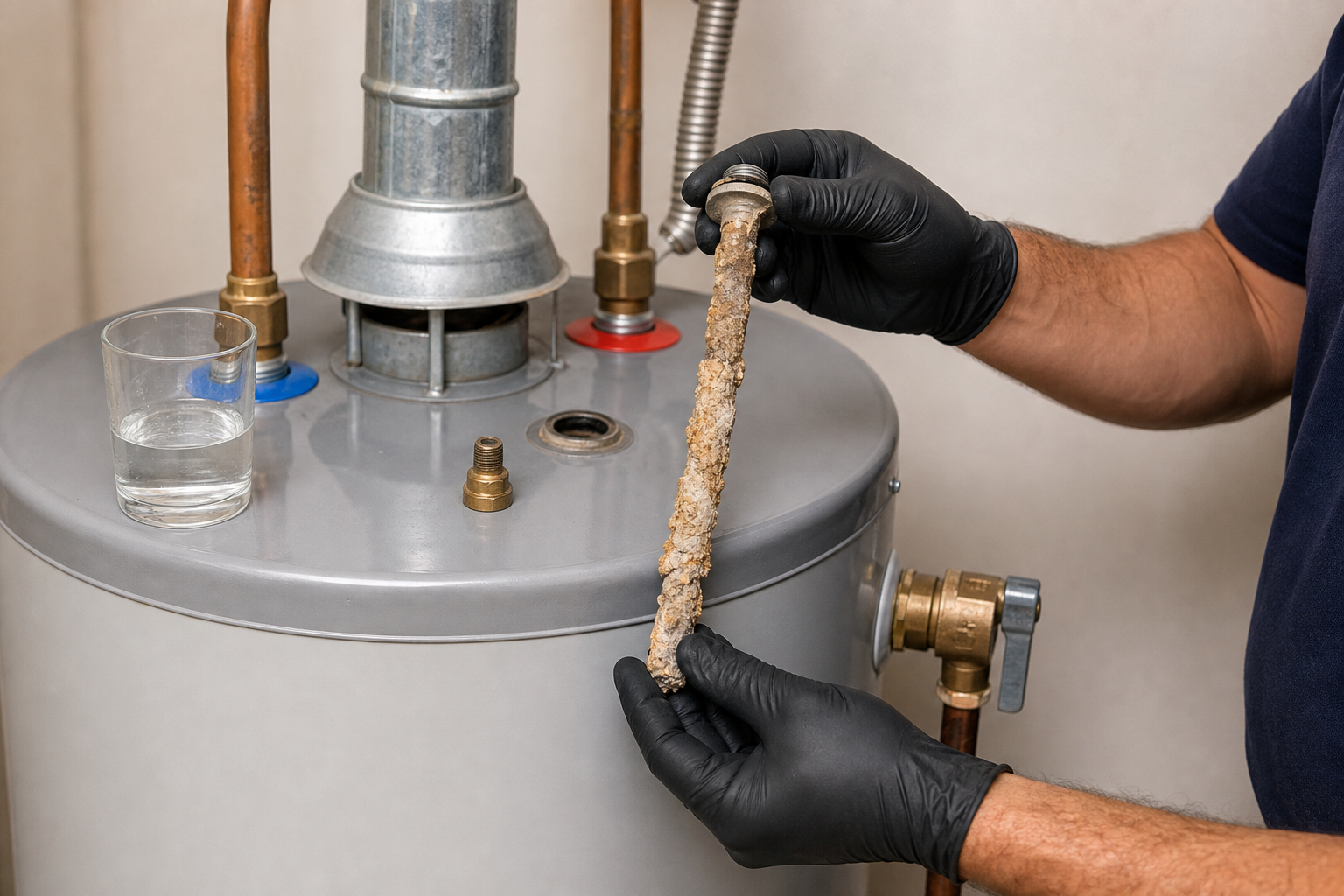
Most conventional steel storage tanks use a sacrificial anode rod. The rod is intended to corrode so the steel tank is less likely to corrode first. Its material, remaining condition, installation, and interaction with the local water chemistry can matter when a plumber investigates hot-water odor.
A corroded-looking anode is not automatically a defect; gradual consumption is part of its job. An anode may still deserve replacement when it has been depleted or when a model-appropriate alternative is supported by the tank and water conditions. Simply removing it can reduce corrosion protection and shorten the tank’s useful life. Choosing a different anode material without understanding the water may also leave the odor unresolved.
Do not loosen or cut the anode, open the tank, drain it for a trial repair, or attempt removal while the unit is hot or pressurized. Anode access can require safe isolation of water, energy, pressure, venting, and nearby piping. Clearance above the tank and the model’s construction also affect how the component can be serviced.
Timing Can Narrow the Diagnostic Branch
The smell’s timing can help distinguish stored-water conditions from a fixture or source-water issue. Record the pattern over normal use rather than repeatedly running hot water to make the odor disappear.
Useful details include:
- Whether the odor is strongest during the first hot-water draw of the day.
- Whether it appears after a weekend away, a vacation, or another idle period.
- Whether it continues through a full shower or fades after a short time.
- Whether it returns after the heater reheats.
- Whether every hot tap began smelling on the same day.
- Whether the cold water ever develops the same odor.
- Whether the water comes from a municipal supply, private well, or shared system.
- Whether a softener, filter, well component, recirculation system, or water heater was recently installed or serviced.
- Whether the odor started after plumbing work, a source-water change, a utility interruption, or a period when the building was vacant.
Also note the heater type, model, approximate age, fuel or energy source, and whether it is a storage tank or tankless unit. Many tankless heaters do not use the same sacrificial-anode arrangement as a conventional tank. A hot-water odor in a tankless system may lead the technician toward source water, hot-water piping, treatment equipment, maintenance condition, or another model-specific component instead.
A One-Fixture Odor May Come From the Drain
A sink drain or overflow passage can hold organic buildup that produces an odor. Warm water can release more odor into the air, making it seem as if the hot supply is contaminated. If the smell stays at one basin and does not follow a glass of water away from the drain, the fixture branch deserves attention.
Do not pour bleach, acid, drain cleaner, peroxide, or mixed household chemicals into the fixture to test the theory. Mixing products can release dangerous fumes or damage finishes, seals, or piping. Do not assume that a drain odor rules out a water-heater issue if other hot taps also smell.
A plumber can compare the water at the fixture with water from another hot tap, inspect the drain and overflow, and determine whether the local plumbing or the heated water is carrying the odor. This prevents a tank treatment from being used for a problem that exists only at one drain.
Hot and Cold Odor May Point Beyond the Heater
When both temperatures smell at several fixtures, the incoming water deserves evaluation. Private wells can experience changing water chemistry or microbial conditions. Municipal water can also pick up odor in building plumbing or treatment equipment after it enters the property. A softener, filter, storage tank, or seldom-used branch can influence the pattern.
Do not select a filter, chemical feed, or disinfection plan based only on a rotten-egg description. A water test should match the actual supply and concern. Depending on the result, the appropriate professional may be a plumber, qualified water-treatment provider, well professional, or public water supplier.
If neighbors on the same supply report a new cold-water odor, note that information and check current guidance from the water supplier. If the odor exists only inside the home, record which fixtures and treatment devices are involved. Those facts help keep a source-water diagnosis separate from a water-heater repair.
Do Not Raise the Temperature or Add Chemicals as a Trial
Online advice sometimes recommends turning the heater hotter, pouring disinfectant into the tank, or changing an anode without testing. Those are not harmless experiments. Higher water temperatures can cause serious scalds. Chemicals require correct product selection, dosage, contact time, flushing, backflow protection, material compatibility, and confirmation that the water is safe afterward.
Do not add bleach, peroxide, acid, cleaners, or water-treatment chemicals to the heater or plumbing. Do not disable a mixing valve, thermostat, temperature limit, relief valve, gas control, electrical safety, or other protective device. Do not cap a temperature-and-pressure relief discharge pipe.
A professional plan may involve tank flushing, model-approved disinfection, anode service, treatment-system correction, source-water work, piping changes, or replacement. The appropriate step depends on the confirmed source, heater condition, manufacturer requirements, and water test results. No single treatment is right for every hot-water odor.
When the Heater Needs Prompt Inspection
Arrange professional assessment when the odor persists at all hot taps, returns after normal use, began after heater service, or occurs with another water-heater symptom. Prompt attention is especially important when you also observe:
- Water collecting beneath the tank or at a connection.
- Rust-colored water, metallic debris, or visible corrosion at the tank.
- Popping, rumbling, hissing, or another new sound.
- Water that is unexpectedly too hot or not hot enough.
- Repeated pilot, ignition, status-light, breaker, or safety-control trouble.
- A damaged vent connector, soot, scorching, or a carbon-monoxide alarm on a fuel-fired unit.
- An odor present around the appliance even when no water is flowing.
An ambient sulfur-like odor, gas odor, carbon-monoxide alarm, soot, scorching, delayed ignition, or illness is not a water-sampling situation. Leave the area and contact the gas utility or emergency services from a safe location. Do not relight the heater or return until the appropriate authority says it is safe.
What a Professional May Check
A useful service visit starts with the hot-versus-cold and fixture-by-fixture pattern. Depending on the heater and water supply, the technician may:
- Confirm whether the odor follows a water sample away from the drain.
- Compare incoming cold water with hot water at the heater and fixtures.
- Review the model, age, installation, maintenance history, and recent plumbing work.
- Inspect the tank, connections, venting or electrical supply, temperature controls, and visible corrosion.
- Evaluate the anode type and remaining condition using model-appropriate procedures.
- Check sediment, recirculation, treatment equipment, and stagnant hot-water branches.
- Recommend water sampling when source chemistry or bacterial conditions are plausible.
- Distinguish a serviceable heater condition from a deteriorated or leaking tank.
- Confirm normal operation and safe water temperature after any authorized work.
The inspection should produce a condition-based recommendation. An anode change may be appropriate for one tank, while another home may need a water-treatment correction, controlled tank service, source-water evaluation, piping work, or replacement. A plumber should explain what was found and why the recommended step fits that heater and water supply.
Frequently Asked Questions
Does Rotten-Egg Odor Mean My Water Heater Is Failing?
Not by itself. The odor can involve water chemistry, bacteria, storage time, sediment, the anode, incoming water, treatment equipment, or a fixture drain. A leaking tank, severe corrosion, unsafe controls, or poor repair value may support replacement, but odor alone does not prove the tank has failed.
Is the Anode Rod Always the Cause?
No. Anode-related reactions can contribute in some water conditions, but source water, bacterial activity, sediment, treatment devices, stagnant piping, and drains can produce similar reports. The anode also protects the tank from corrosion, so removing it without a model- and water-specific plan can create another problem.
Why Is the Smell Worse After We Have Been Away?
Water has remained in the heater and hot-water piping longer, giving existing chemical or bacterial conditions more time to affect odor. That timing is useful evidence, but it does not identify the exact cause. Record how long the home was idle and whether the odor affects every hot tap.
Can I Keep Using the Hot Water?
Do not use the system when there is any chance of a fuel-gas leak, carbon-monoxide problem, overheating, contaminated water, or another immediate hazard. For an odor clearly limited to flowing hot water with no ambient gas warning, avoid drinking or cooking with questionable water until the source is understood. A plumber or water-quality professional can advise based on the actual condition and test results.
Will Flushing the Tank Fix the Odor?
Flushing may help when sediment or stored water is part of the condition, but it will not correct every anode, source-water, bacterial, treatment, or tank problem. Improper draining can cause burns, flooding, dry-firing, or damage. Have the cause and the heater’s condition assessed before choosing the remedy.
Does a Tankless Water Heater Have the Same Problem?
Usually not through the same storage-tank anode process. Tankless equipment may still deliver odorous hot water because of incoming water, treatment devices, hot-water piping, maintenance condition, or a model-specific component. Give the technician the exact model and describe whether cold water has the odor too.
Get the Hot-Water Odor Diagnosed in Sacramento
A rotten-egg odor at every hot tap is a reason to inspect the water heater and compare the heated water with the incoming supply. The safest next step is to document where the odor occurs, when it is strongest, recent plumbing or treatment changes, and whether cold water ever smells the same. Do not remove the anode, raise the temperature, add chemicals, or keep investigating when the odor may be fuel gas.
Contact Dependable Rooter & Plumbing to arrange a Sacramento water-heater assessment. Share the heater model, age, water source, fixture pattern, timing, recent work, and any leak, corrosion, temperature, sound, ignition, or venting symptom. Those details help the technician test the right branches and recommend only the repair, water evaluation, or replacement supported by the condition found.